Facebook
 X
X
 Pinterest
 Copy Link
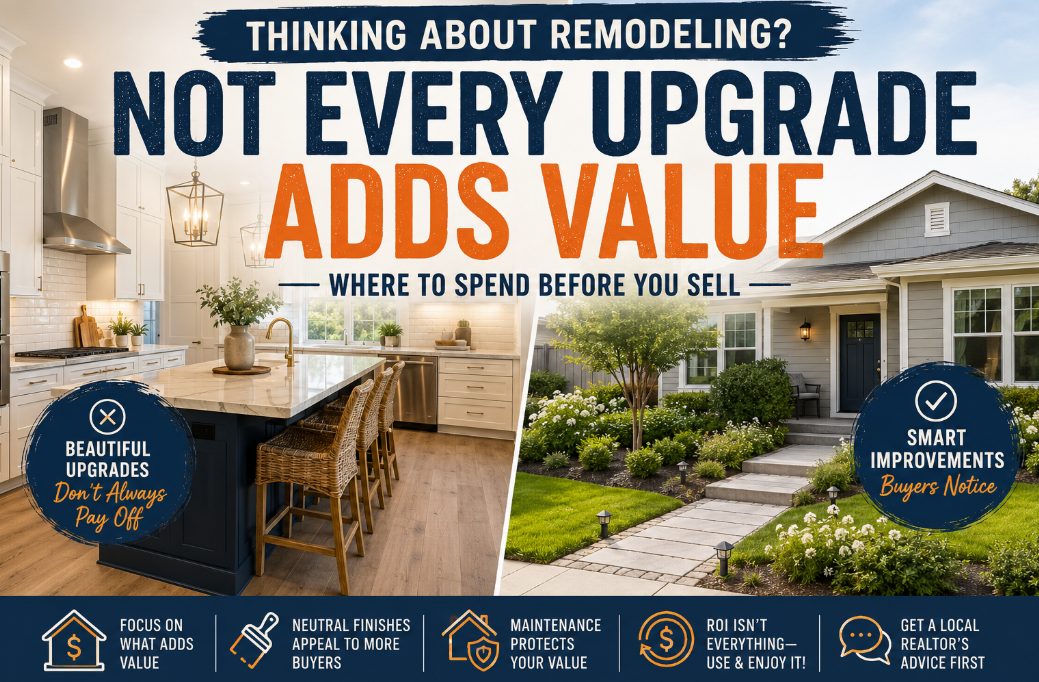
One question homeowners ask me all the time is which home renovations actually add value when it comes time to sell.
Unfortunately, it doesn’t always work that way.
I’ve walked through homes where the owners spent a significant amount of money replacing all of the flooring. They chose quality materials, had everything professionally installed, and understandably considered it a major upgrade to the property.
Then the new owners bought the house and ripped it all out because they didn’t like the style.
That doesn’t mean the original owners wasted their money. They may have enjoyed those floors for years. However, if they installed them specifically because they thought they’d get every dollar back when they sold, that’s where expectations and reality can be very different.
It’s one of the reasons I think homeowners should separate two questions:
Will this make my home better for me?
and
Will a future buyer actually pay more for it?
Sometimes the answer to both is yes. Other times, not so much.
Start With the Improvements Most Buyers Appreciate
If resale value is the priority, I generally like improvements that appeal to the widest group of buyers.
Kitchens and bathrooms are obvious examples, but even here, I don’t think you need to go crazy.
A dated kitchen can absolutely hurt a home’s appeal. At the same time, spending $100,000 creating your dream kitchen doesn’t necessarily mean the home is suddenly worth $100,000 more.
Instead, a clean, functional kitchen with updated finishes will usually appeal to more buyers than something extremely expensive and highly personalized.
The same idea applies to bathrooms, flooring, lighting, and other finishes throughout the home.
Neutral doesn’t have to mean boring. It just means you’re giving the next owner enough room to picture themselves living there.
Flooring Is a Great Example
Flooring is one of the upgrades where I’ve personally seen homeowners overspend.
It makes sense. Floors run throughout the house, so replacing them can completely change how a property feels.
However, flooring is also incredibly subjective.
One person loves dark hardwood. Another wants light oak. Someone else wants luxury vinyl because they have kids and a dog.
I’ve seen homeowners spend a lot of money installing beautiful floors only for the next owners to replace them almost immediately.
So, if you’re planning to sell relatively soon, I wouldn’t necessarily choose the most expensive flooring available. I’d focus more on whether the home feels cohesive, clean, updated, and appealing to a broad range of buyers.
This is also why I tell buyers to think carefully about choosing the better house versus the better location. Cosmetic finishes are some of the easiest things about a property to change.
If you’re planning to stay for another ten years? That’s different. Put in the floors you want to live with.
Sometimes the Boring Improvements Matter More
This is another area where homeowners can get frustrated.
A new roof isn’t particularly exciting.
Neither is replacing old plumbing, updating an electrical panel, repairing drainage, or installing a new HVAC system.
Unfortunately, buyers don’t usually walk into a house, see a new sewer line, and immediately decide to pay $30,000 more.
However, they absolutely notice when those things haven’t been taken care of.
That’s why I think of many of these projects less as “value-adding renovations” and more as protecting the value that’s already there.
For example, a buyer may not pay a massive premium because you installed a new roof. On the other hand, an old roof nearing the end of its life can quickly become a negotiating point during escrow.
There’s value in removing those objections, even if it’s harder to see on paper.
Don’t Underestimate the Simple Stuff
If you’re preparing a home specifically to sell, this is where I think homeowners sometimes make things unnecessarily complicated.
You may not need a brand-new kitchen.
Sometimes you need fresh paint, updated light fixtures, landscaping, a deep cleaning, some repairs, and someone willing to tell you which things buyers are actually going to notice.
I’ve seen relatively small cosmetic changes completely change the first impression of a property.
Curb appeal matters too. Buyers start forming an opinion before they even walk through the front door. Cleaning up landscaping, painting the front door, replacing tired exterior lights, or pressure washing hardscape isn’t particularly glamorous, but collectively those improvements can make a home feel much better maintained.
I’d much rather see a seller spend strategically across the property than dump the entire budget into one room while everything else still feels dated.
What About Pools in Orange County?
Pools are an interesting one because we’re in Southern California.
For the right buyer, a great backyard with a pool can be a huge selling point. Our weather allows people to actually use it, and an attractive outdoor space can become another entertaining area for the home.
However, not every buyer wants one.
Pools require maintenance, take up yard space, and can even be a negative for buyers who would rather have grass or a larger open backyard.
So I wouldn’t install a pool simply because you’re hoping to increase resale value.
If your family wants a pool and plans to enjoy it for years, that’s a completely different conversation.
ADUs Can Be Different
ADUs have become particularly interesting in Orange County because they can potentially create something many cosmetic renovations can’t: additional usable space and potentially additional income.
However, an ADU isn’t automatically a home run.
The lot, parking, privacy, construction costs, layout, and neighborhood all matter. You also have to consider what you’re giving up to build it.
For example, adding an ADU that takes over most of an otherwise great backyard could make the property more valuable to one buyer and less attractive to another.
Again, it comes back to the individual property.
Always be sure to follow state and local laws if taking on an ADU project.
Be Careful About Over-Improving
This might be the biggest thing I’d consider before taking on an expensive renovation.
At some point, the neighborhood starts putting a ceiling on what buyers are willing to pay.
If similar homes around you sell for $1.2 million, putting $400,000 into your property doesn’t automatically make it a $1.6 million house.
You may create the nicest home on the street, and there’s certainly value in that. However, buyers will still compare your property with everything else they can purchase at that price.
Before taking on a major renovation, I’d want to understand what remodeled homes are actually selling for nearby.
Not Every Renovation Needs to Make Money
This is probably the most important point.
Your home isn’t just an investment. It’s also where you live.
If you spend $30,000 creating a backyard your family uses every weekend for the next eight years, I wouldn’t call that a bad investment simply because it only adds $15,000 to the eventual sale price.
You got eight years of use out of it.
The same goes for a dream kitchen, custom flooring, a pool, or anything else you genuinely want.
The calculation only changes when you’re making improvements specifically to sell.
At that point, I’d stop asking:
“What would I want?”
and start asking:
“What will make the largest number of buyers want this house?”
Those can lead to very different decisions.
Before You Spend the Money
If you’re thinking about selling within the next year or two, I’d talk with a Realtor before starting a major renovation.
Not because Realtors are contractors or designers, but because we’re constantly walking through homes with buyers and seeing their reactions.
We see which improvements they get excited about, which ones they don’t care about, and which problems immediately become negotiating points.
Sometimes the advice might be to remodel.
Other times, it might be to paint, clean things up, fix a few problem areas, and leave the rest alone.
If you’re going to spend money getting your home ready to sell, the goal shouldn’t be to spend the most.
It should be to spend it where buyers are actually going to notice.
And there are even great companies like REVIVE that can cover the upfront costs for you.
Thinking about selling in the next year or two? Before you start remodeling, I’m happy to walk through your home and give you my opinion on where I’d spend the money—and where I wouldn’t.
Sometimes the best pre-sale renovation is the one you decide not to do.