Facebook
 X
 Pinterest
 Copy Link
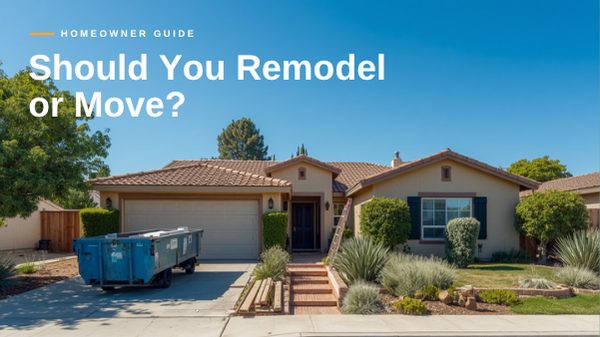
At some point, almost every homeowner hits the same wall. The kitchen feels cramped, there’s one bathroom too few, or the layout just doesn’t fit your life anymore. That’s when the big question shows up: do you fix the house you have, or go find one that already works?
In a lot of places, that’s mostly a question of taste. In Orange County right now, it’s also a math problem. Interest rates, property taxes, and remodel costs all point in different directions, and the right answer depends on which of them hits you hardest.
So instead of giving you a one-size answer, I want to walk through how I’d actually think about it.
Start With What’s Really Wrong
Before you price out a contractor or browse listings, name the problem as specifically as you can. Most frustrations fall into one of two buckets.
The first is the house itself. Maybe the kitchen is closed off, the bathrooms are dated, or you need an office that doesn’t double as a guest room. These are often fixable, sometimes without adding a single square foot.
The second is where the house is. Maybe your commute has gotten longer, or you want to be closer to family or the beach. You might also simply want a different pace of neighborhood. No remodel can fix that.
This sounds obvious, but it saves a lot of wasted energy. If the problem is location, remodeling only makes you comfortable in the wrong place. On the other hand, if you love where you live and the problem is two dated bathrooms, moving may be an expensive way to solve a fixable issue. I’ve written before about the trade-off between the better house and the better location, and the same idea applies here.
Why the Math Is Different in Orange County Right Now
Your Current Mortgage Rate
This is the biggest factor for many homeowners. According to Freddie Mac, the average 30-year fixed rate was 7.40% as of October 8, up from 6.30% a year earlier.
If you bought or refinanced when rates were around 3%, that difference is real money. For example, a $800,000 loan at 3% runs about $3,370 a month in principal and interest. That same loan amount at 7.4% runs about $5,540. That’s roughly $2,170 more every month, before taxes or insurance.
As a result, many homeowners with low rates are choosing to stay put and improve what they have. That isn’t the right call for everyone, but it’s worth running your own numbers before assuming a move is the obvious answer.
Your Property Tax Base
California’s Prop 13 keeps your property taxes tied to what you paid, with yearly increases capped at 2%. When you buy a new home, your tax base generally resets to the new purchase price. For long-time owners, that reset can mean thousands of dollars more each year.
There’s an important exception for homeowners 55 and older. Under Prop 19, eligible homeowners can transfer their tax base to a replacement home anywhere in California, up to three times. If the new home costs more, part of the difference gets added on, so it isn’t always a perfect transfer. Still, it can change the math a lot for downsizers and long-time owners. I covered the details in my Prop 19 post.
The Cost of Selling and Buying
Moving also means paying to sell one home and buy another. Agent fees, escrow, title, transfer taxes, moving costs, and repairs before listing all add up quickly. Next week, I’m breaking down exactly what it costs to sell a home in Orange County, because it’s one of the most underestimated parts of this decision.
What Remodels Actually Return
If you’re leaning toward remodeling, it helps to know which projects tend to pay you back and which ones are mostly for your own enjoyment.
There isn’t a remodeling report that breaks out Orange County on its own. The closest is the 2025 Cost vs. Value Report for the Los Angeles area, which gives a useful sense of direction:
- Minor kitchen remodel (midrange): about $30,000, recouping roughly 127% at resale
- Midrange bathroom remodel: about $27,000, recouping roughly 90%
- Major kitchen remodel (midrange): about $86,000, recouping roughly 57%
- Primary suite addition (midrange): about $183,000, recouping roughly 32%
The pattern matters more than the exact numbers. Smaller kitchen and bath updates tend to hold their value well. Big additions, on the other hand, are usually something you do because you’ll enjoy them, not because you’ll get the money back.
Keep in mind that construction often costs more here than these averages suggest, so get real bids before you count on any number. What buyers will pay depends on your street and your price point. In Huntington Beach, I’d look at what remodeled homes near you actually sold for compared with similar homes that weren’t updated. That comparison tells you more than any regional average. I went deeper on this in my post on renovation ROI before selling.
When Remodeling Probably Makes More Sense
Remodeling is often the better move when most of these are true:
- You love your location and can’t easily replace it at today’s prices.
- The problem fits within your footprint, such as a layout, kitchen, or bathroom issue.
- You have a low mortgage rate or a low property tax base you’d lose by moving.
- The project won’t over-improve your home for the neighborhood.
- You can realistically live through the work, or stay somewhere else while it happens.
That fourth point matters more than people think. If your remodel pushes your home far above everything else on the street, you may not get that value back when you eventually sell.
When Moving Probably Makes More Sense
On the other hand, moving usually wins when:
- The location itself is the problem.
- You need more space than your lot or zoning allows.
- The remodel would cost close to the price difference of simply buying a home that already has what you want.
- Your life is changing in a way one project won’t solve, like a new job, retirement, or downsizing.
- You qualify for Prop 19 and can keep your tax base while moving.
There’s also the stress factor. A major remodel can take months longer than planned and cost more than the first estimate. Some people handle that fine. Others would much rather pack up once and be done.
The Middle Options People Forget
The decision isn’t always all or nothing. A few in-between paths can work well here.
A smaller, targeted remodel can solve most of the frustration for a fraction of the cost. For example, opening up a wall or updating one bathroom might be enough.
An ADU or garage conversion is another option. California has made accessory dwelling units much easier to build, and they can add space for family, a home office, or rental income. They aren’t cheap, though. The same Cost vs. Value report puts an ADU near $179,000 with about 40% recouped at resale, and that number doesn’t count rental income or family use. If you’re considering one, start with the City of Huntington Beach’s planning department, since lot size and setbacks matter.
A Simple Way to Compare Your Options
If you’re stuck, try putting both paths side by side with real numbers:
- Remodel: the project estimate plus a 15–20% cushion, any temporary housing, and how long you plan to stay.
- Move: selling costs, buying costs, moving costs, your new monthly payment, and your new property tax bill.
- The non-financial side: your commute, your neighbors, your routine, and how much disruption you’re willing to live with.
Once it’s all written down, the answer is often clearer than it felt in your head.
So, Remodel or Move?
There’s no universal right answer. Some people are better off staying and improving a home in a location they love. Others are spending money to fix a house that will never fit the way they want to live.
What matters is making the decision with real numbers instead of assumptions. If you’re weighing this right now, I’m happy to help you look at what your home might sell for, what a move would actually cost, and what’s on the market in the areas you’re considering. Sometimes the best outcome of that conversation is realizing you should stay.
James Cool, The Cool Realtor